Essential Guide to Car Passing: Your Complete Road to Vehicle Inspection Success
Let’s talk about that nagging feeling in the back of your mind every time your vehicle registration renewal notice arrives. That mix of obligation and anxiety about the official inspection—will your car make the cut? You’re not just imagining things; the vehicle inspection process is a precise, non-negotiable benchmark for road safety and environmental standards. It’s here that knowing and making use of the professional Car Passing service becomes your most valuable tool. At Car Medic, we have built a reputation on the transformation of this stressful need into an almost seamless experience coupled with confidence. We won’t just hope your car will pass; we’ll prepare it to pass. To schedule a professional, thorough pre-inspection assessment that leaves nothing to chance, don’t hesitate to contact one of our experts today at 0561145797.
Demystifying “Car Passing”: More Than Just a Sticker
While it may sound so plain in everyday conversation, “car passing” carries immense weight in the world of automotive compliance. Essentially, when a car is said to have passed, that means it has been subjected to and satisfactorily passed all the requirements of a government-mandated vehicle inspection. It represents a governmental seal of approval that verifies that your car, truck, or SUV is legally roadworthy—safe for you, your family, and everyone else on the road.
Think of it as a comprehensive health check-up with legal consequences. Unlike a routine service where a mechanic suggests repairs, a formal roadworthiness test has binary outcomes: pass or fail. A pass gives you the legal right to drive on the road and usually comes with a new registration sticker or certificate. A fail legally declares your vehicle unfit for public roads until you fix the identified issues and return for retesting. Many regions also refer to this process as a smog check, MOT test, or safety inspection. This process sets and enforces critical standards for vehicle safety, emissions control, and overall mechanical roadworthiness.
Why Does This Inspection Exist? The Bigger Picture
It’s easy to view this as some kind of bureaucratic annoyance, but the rationale behind the rule is extremely important. These required inspections achieve three critical public goals:
They ensure that every vehicle on the road has functional brakes, proper steering, secure tires, and working lights. This directly prevents accidents caused by mechanical failure.
- Environmental protection: Through the strict emission test, they ensure that harmful pollutants such as carbon monoxide, hydrocarbons, and nitrogen oxides are not emitted into the atmosphere through defective exhaust systems.
- Roadworthiness Standardization: They create a uniform baseline for mechanical fitness that protects used car buyers and offers a safer overall driving ecosystem for all.
This alone means going against a detailed checklist of technical requirements. A professional car passing service exists to be your guide and mechanic through this terrain, making sure your vehicle doesn’t just meet but exceeds these essential standards.
The Official Inspection Checklist: What Testers Actually Look For
Knowledge is power. By knowing the exact points that an inspector will check, one will appreciate the depth of a proper precheck. While regulations about specific items may change, the overall core components of a vehicle inspection test are remarkably similar.
1. The Braking System: Your Primary Safety System
This could be considered the most important part of the safety check. Inspectors don’t just tap the brake pedal; they do an in-depth analysis of the whole braking system.
- Brake Performance: They test the braking force and balance on roller machines to ensure the car stops evenly and effectively.
- Component Condition: They visually examine the brake pads and brake discs (rotors) for wear, scoring, or damage. Thickness measurements are made to verify that they are above the minimum legal requirement.
- Hydraulic Integrity: The brake lines are inspected for leaks, corrosion, or damage. The level and condition of the brake fluid are also inspected because old and contaminated fluid can boil and lead to brake failure.
- Parking Brake: Testing the holding power of the handbrake or electronic parking brake on an incline.
Common points of failure are wear in brake pads at or below minimum thickness, warped or severely scored rotors, a spongy brake pedal indicating air in the lines, and/or a faulty parking brake.
2. Lights, Signals, and Electrical Functions: Communication Is Key
Each light on your vehicle is a communication device. The inspectors will systematically check every one.
- Exterior Lights: Headlights—low and high beam, tail lights, brake lights, turn signals—front, rear, and side markers, reverse lights, and license plate lights. They check for proper operation, brightness, and color.
- Safety Signals: Hazard warning lights must flash in unison.
- Visibility Aids: The windshield wipers should clear the screen without streaking; the washer fluid system should work. The horn should honk at a reasonable volume level.
- Common Failure Points: Burnt-out bulbs are the single most common reason for failure. Cracked or discolored lens covers, a weak horn, or perished wiper blades are also regular culprits.
3. Tires, Wheels, and Suspension: The Foundation of Control
This section evaluates your car’s grip on the road.
- Tire Tread Depth: Inspectors measure tire tread depth with an accurate gauge. It needs to be above the legal minimum—typically 1.6 mm across the central three-quarters of the tire’s width—and wear must be even. Any bald tires or those worn out in an illegal manner automatically fail the test.
- Tire condition: They check for any cuts, bulges, and sidewall cracks, or anything embedded that can lead to a blowout.
- Suspension & Steering: Checks on components such as shock absorbers, struts, ball joints, tie rod ends, and bushings are done for excessive wear, damage, or leaks. Worn suspension parts lead to poor handling and uneven tire wear.
- Alignment: Severe misalignment, sometimes very obvious with uneven tire wear, will be noted.
- Common Failure Points: Tires worn below the legal limit, damaged sidewalls, leaking shock absorbers, or excessive play in steering joints.
4. The Exhaust Emissions Test: The Environmental Check
The smog check, or emissions test, is a major pillar of the inspection, as it has to do with your car’s environmental impact.
- Tailpipe Emissions: A probe is inserted into the exhaust to measure levels of harmful gases. The vehicle’s computer (OBD-II system) is also scanned.
- The “Check Engine” Light: A lit Check Engine Light (MIL) is typically an automatic and immediate failure in most jurisdictions. This indicates that the car’s computer has found some kind of fault in either the engine or its emissions system.
- Physical Exhaust Condition: The exhaust system is inspected for leaks, holes, or excessive corrosion, with particular emphasis on the catalytic converter responsible for lowering pollutants.
- Common Failure Points: An illuminated check engine light, a failed catalytic converter, leaking exhaust manifolds, or faulty oxygen sensors that cause the engine to run too rich or too lean.
5. Structural Integrity and General Roadworthiness
This is a broad category covering the vehicle’s overall condition.
- Body and Chassis: Inspectors look for excessive rust damage or corrosion, with a focus on structural areas like the frame, floor pans, or suspension mounting points.
- Seatbelts and Restraints: All seatbelts must latch securely, retract properly, and show no significant fraying or damage.
- Windshield and Glass: A fail is normally called if cracks or chips are directly in the driver’s line of vision. Other windows must be secure.
- Mirrors: Side mirrors and the rearview mirror are required to be present, secure, and free from obstruction.
- Fluid Leaks: Any significant leak of oil, coolant, transmission fluid, or power steering fluid that is a hazard to the environment or vehicle safety will result in failure.
The Car Medic Pre-Inspection Process: Your Strategic Advantage
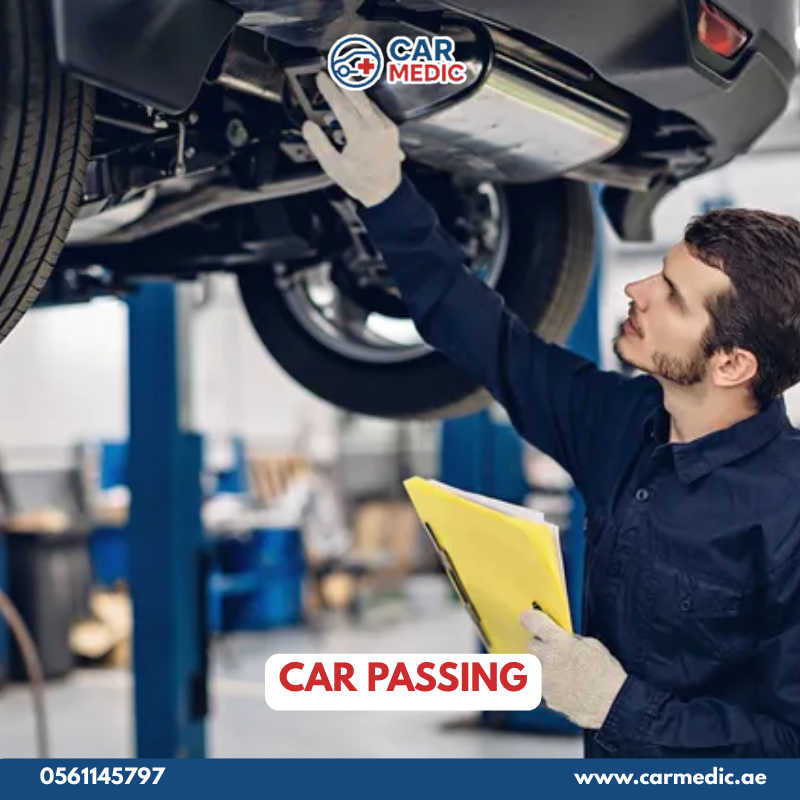
At Car Medic, our car passing package is engineered to be more thorough than the official test itself. We operate on a simple principle: find and fix every potential issue on our lift, not at the testing center. Here is our multi-step, in-depth process:
Stage 1: Advanced Computerized Diagnostics
We start by connecting directly with your vehicle’s brain. Using professional-grade scanners, we:
- Read all stored and pending diagnostic trouble codes from the engine, transmission, ABS, and airbag systems.
- Check monitor readiness status. Once a battery disconnect or code clear has occurred, your car’s computer needs to rerun a set of self-tests called a “drive cycle.” The inspection computer will check to see if these monitors are “ready.” Too many “not ready” monitors can cause a failure.
- Interpret live data from key sensors to spot intermittent issues that may not be triggering a permanent code.
Stage 2: The 360-Degree Visual and Mechanical Inspection
Following that is a hands-on inspection performed by our certified technicians, mirroring—and often exceeding—the official protocol.
Emissions System Pre-Check:
We inspect the entire exhaust path, check all visible emissions-related components, and confirm that the gas caps seal properly.
Comprehensive Brake Analysis:
We remove the wheels to visually measure pad and rotor thickness—something the official test often skips—and we inspect all brake lines and hoses.
Light and Electrical Check:
Two technicians test each light and electrical function, with one operating the controls from the driver’s seat while the other confirms the results outside.
Tire and Suspension Check:
We measure tread depth in multiple spots on each tire. We lift the vehicle on a hoist to inspect the suspension, steering components, and chassis for rust or damage.
Interior and Safety Device Check:
We test the seatbelts, mirrors, horn, and wiper/washer systems to ensure everything functions properly.
Stage 3: Transparent Reporting and Collaborative Planning
No confusing work orders are handed to you. Instead, we provide a clear, itemized report that categorizes findings:
- Critical Fail Items: Issues that will automatically be rejected at the official test.
- Advisory Items: Components showing wear that are within limits at this time but should be monitored.
- Minor Notes: Cosmetic or non-safety-related observations.
An advisor at Car Medic will walk you through each item, explain why it matters, and present your repair options with upfront pricing.
Stage 4: Expert Repair and Final Verification
Our technicians perform repairs using quality parts upon your approval. Then, after the repair is made, we don’t assume it’s fixed. We:
- Re-scan the computer to confirm that fault codes are resolved and monitors are resetting.
- Carry out a focused re-check of the repaired systems.
- Take a short road test to confirm that the braking, steering, and alignment feel right.
This truly defines a professional vehicle inspection preparation, an end-to-end service.
The Compelling Benefits of Investing in a Professional Pre-Check
Visiting Car Medic before your appointment is not additional spending but rather a strategic investment that pays many dividends.
- Financial Savings: A failure costs you a first test fee, a retest fee, and frequently premium rates for hurried repairs to meet a retest deadline. Our pre-check enables planned, economical repairs and ensures that you are never billed more than once—the official test fee.
- Time Efficiency: The official testing center is not a repair garage. If you fail, you will have to leave, find a mechanic, get the work done, and rebook a test, and the process can take several days or even weeks. We consolidate everything into one stop, saving you hours of personal hassle.
- Stress Elimination: It eliminates the uncertainty of the test. You walk into the official inspection with a detailed report from professionals, knowing your vehicle is prepared. The confidence this instills is priceless.
- Expert Diagnostics, Not Guesswork: Most especially with emissions failures and Check Engine Lights, proper diagnosis is important. We identify root causes, such as a failing mass airflow sensor or evaporative emissions leak, instead of simply replacing random parts.
- Improved Safety: This procedure ensures that your Car Passing is not only compliant with the law but actually safe to operate. Every day, you will know that your brakes, tires, and lights are all operating at ideal levels.
FAQs Regarding Car Passing
1. What is the difference between a regular service and a car passing pre-inspection?
A regular service is a tune-up, such as an oil change, and involves replacing worn-out items periodically and general checks. A pre-inspection, on the other hand, is a compliance-focused diagnosis, with the official test checklist serving as the guide in finding any specific item that would make a government inspector fail the vehicle. It’s a targeted pass/fail evaluation.
2. The check engine light in my car is on. Can you assure me that it will pass after you fix it?
We can guarantee the repair of the underlying fault causing the light. Once repaired, we clear the code. However, afterwards, the car’s computer needs to go through its drive cycle to reset all its self-check monitors. We will guide you through the drive cycle procedure, and when you complete it before the official test, your vehicle will be ready for the OBD-II emissions check. We will fix the fault and confirm that the monitors reset correctly.
3. How long does the pre-inspection service take, and how far in advance should I book?
The typical initial inspection and diagnosis takes 60-90 minutes. The time taken for a repair depends on what we are finding. We strongly advise booking your pre-check 7-10 days in advance of your official test appointment. This gives us the appropriate time to make needed repairs and order any parts necessary, and it gives you time to complete a drive cycle if needed.
4. Do you offer any kind of “pass guarantee” if I use your service?
We cannot legally guarantee the outcome of a third-party government test, but we can assure you that if your vehicle fails its official inspection for an item on our report that we called “passed” or “within specification,” we will reinspect that item for no charge and cover the cost of any related repair we missed. Our process is designed for a first-time pass, and we stand behind our work.
5. Are you able to help with older cars with rust or cars that have been modified?
Of course, we can offer honest evaluations for all vehicles. On older cars, we are able to advise if there is any structural rust that may be a problem. On modified vehicles, we can advise if aftermarket parts (exhausts, suspension, etc.) are likely to comply with inspection standards. Our goal is to give you a clear, honest picture of your vehicle’s inspection readiness.
Take Control of Your Vehicle’s Compliance Journey.
The path to a successful car passing result doesn’t need to be fraught with anxiety and unexpected failures. It can be smooth and informed and culminate in a simple formality at the testing center. With a professional pre-inspection service, you are taking proactive control to protect your time, your budget, and most importantly, your safety on the road. At Car Medic, we merge expert technical know-how with an unparalleled commitment to clear communication. We commit to giving you the knowledge and repairs needed to bring your vehicle to peak condition, fully ready to meet every standard on the official checklist.
Don’t gamble with your inspection; make the smart choice that thousands of drivers trust. Contact Car Medic today at 0561145797 to schedule your comprehensive pre-inspection. Let us provide the expertise and thorough care that assures you drive away confident, compliant, and with complete peace of mind. Your road-ready vehicle awaits.